
 Invro Home
Triple frequency injection adds 30% to the power rating of a transmission line.
Or keep the power the same and swap Amps for Volts to reduce losses by 33%
Who should be interested in this? Grid and distribution system operators.
Any business making equipment for these organisations.
Any energy business looking to transition from fossil fuels to renewable electrical energy.
Constructors of vehicles and power systems for ships aircraft and land vehicles where weight and effciency matter.
Nations looking to install a long distance power transmission system.
Subsea transmision system operators and equipment providers for these.
Transformer manufacturers.
Cable makers.
Power station builders.
The Principle
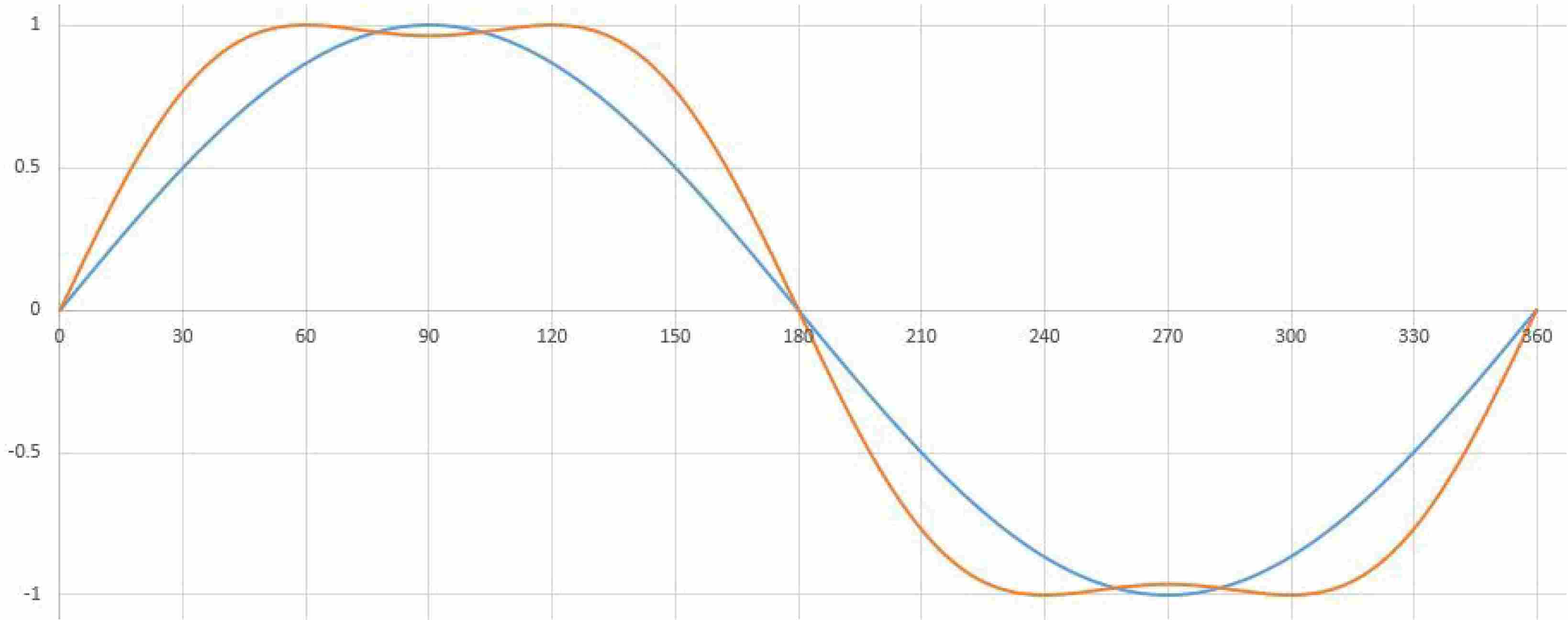
Adding 1/6th third harmonic to the ac supply waveform (a sinusoid) permits the maximum theoretical power capability of a transmission system to be increased by 33%.
Alternatively the power can be kept constant and voltage increased and current reduced thereby lowering line losses due to resistance by up to 33%.
Third harmonic injection gives some of the benefits of DC transmission while keeping the immense advantages of AC.
As the waveforms above illustrate, third harmonic injection in a section of a transmission system allows that section to operate for most of each cycle at close to peak allowable voltage. Adding 1/6th of third harmonic lowers the peak value of a sinusoidal waveform by a factor of 0.866. Restoring the combined waveform to the allowable peak value for the transmission line raises the fundamental voltage by a factor of 1.155.
This principle has been widely used for many years to raise the output voltage in three-phase inverters. ("The use of harmonic distortion to increase the output of a three-phase PWM inverter". Houldsworth J.A. and Grant D.A. IEEE Transactions of the Industry Applications Society, Sept 1984, pp 1224-1228).
The P(max) of a power transmission line is proportional to V2. Therefore the raising of the fundamental voltage theoretically permits P(max) to be increased by a factor of 1.33 (subject to the conductors being able to support a 16% increase in current).
The blue waveform shown above is the line-ground waveform before the addition of the third harmonic. The orange waveform is the line-ground voltage after the addition of the third harmonic and amplification by 1.156.
In conventional ac power systems which employ a pure sine wave, the line-to-line Voltage is limited. The benefits are more power capacity and/or reduced losses.
The third harmonic is stripped out as the power passes through the receiving end transformer – or if advantageous, it can be taken out later – or not at all depending on the end uses.
Power is normally limited by the peak permitted line-to-ground voltage and the use of a sinusoidal waveform. By breaking that link by adding a third harmonic we allow the line-to line Voltage to be increased by 15.6% and the power limit increased by up to 33%.
For a pure sine wave, V(line-to-line) = Vpk(line-ground)/√2 x √3 = Vpk(line-ground) x 1.225
For a sine wave plus third harmonic, V(line-line) = Vpk(line-ground) x 1.156/√2 x √3 = Vpk(line-ground) x 1.416
A pure sine wave uses the maximum allowed line-ground Voltage once every half cycle.
A sine wave plus third harmonic uses the maximum allowed line-ground Voltage twice every half cycle.
Adding a third harmonic moves the performance of an ac line closer to that of a dc line. The benefits are more power capacity and reduced losses.
The third harmonic is stripped out as the power passes through the receiving end transformer. The simplest way to implement this principle is by connecting the sending end and receiving end transformer windings in star and by applying the triple frequency voltage waveform to each star point as shown below.
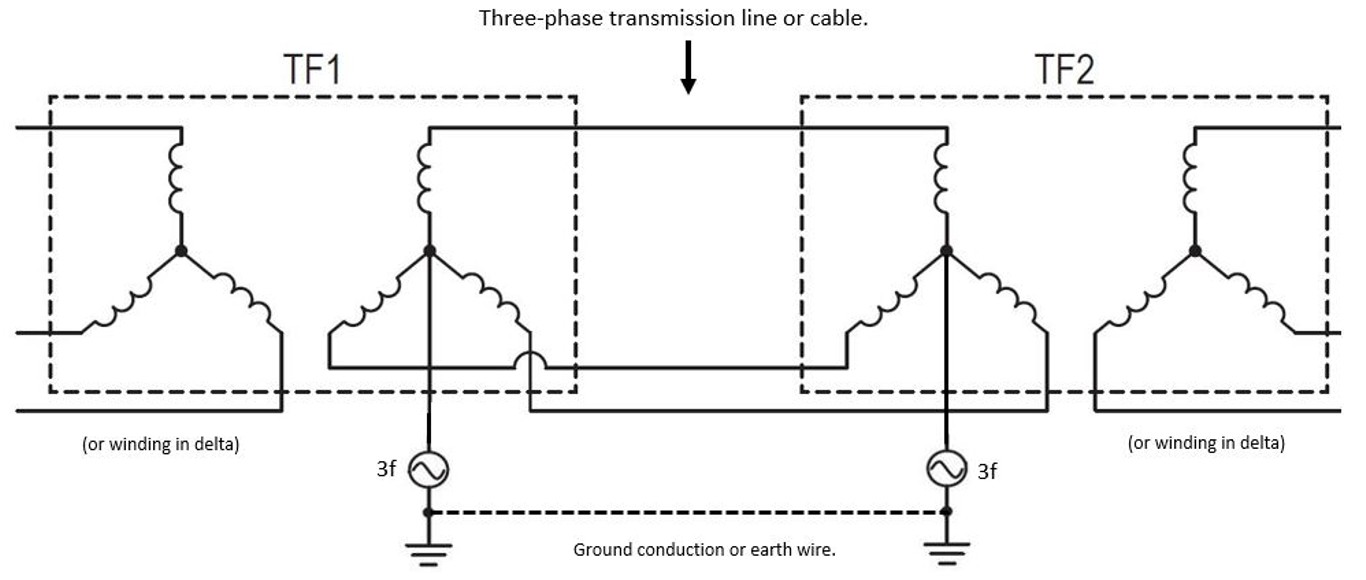
The transmission system therefore operates to some extent at the triple frequency as well as the fundamental frequency. This creates challenges for the triple frequency injectors (labelled 3f in the circuit diagram). We offer a solution to the challenges created by fundamental-frequency zero-sequence currents in the injectors (patent applied for). We have also have a range of solutions for the challenges of integrating this technology into new or existing power transmission systems (patent applied for). See Power and Energy. Further patent activity is envisaged, relating to line injection of the third harmonic, control of the propagation of the third harmonic and special three-phase transformers for this application. See Patents.
Power and Energy
Patents
Resources